

January 26th, 2026
How to Choose the Right Race Nutrition (And What to Try From the Centurion Store)
Featured in this article

Nutrition is one of the big puzzles in ultra-running. Some runners dial in the right fuelling strategy early and never look back; others spend years experimenting with gels, powders, chews, “real food”, and the occasional desperate handful of something unlabelled from an aid station bowl. Most of us fall somewhere in the middle.
“The aim of the Centurion running store is to provide the very best range of appropriate fuel hydration and nutrition products for our sport” Centurion Running’s James Elson tells us. “We always stock the same products that feature on our checkpoints as well as a wide range of the best available sports nutrition.”
The good news is that a smart nutrition plan doesn’t need to be complicated. You don’t need spreadsheets, gastric diagnostics, or a PhD in biochemistry (although the first two might help). What you do need is an understanding of what works for you, a willingness to test different options, and access to a good range of products you can trust, something the Centurion Running Store curates exceptionally well.
We stock a huge range of sports hydration and nutrition options to help you fuel to success. Check out the range here.
Here’s how to think about choosing your race nutrition, and how to pick the right products to try in training.
1. Start with the basics: carbs, comfort, and consistency
Every ultra-runner has slightly different needs, but most will perform well on a steady stream of carbohydrate-based fuel. Forget the myths about fat adaptation and magic bullets, when the miles start adding up, carbs are your friend. What matters is how you get them in.
The aim for long events is to eat or drink small, regular amounts from the very beginning, not waiting until you’re hungry. Think of your energy like a campfire: a few small sticks added frequently keep it burning; throw one big log on too late and you’ll just get smoke.
The products in the Centurion Store reflect this philosophy: simple, portable, digestible options you can tuck into a vest pocket and not think twice about.
2. Choose formats that actually work for you
There’s no rulebook that says you must use gels, drink mixes, or chews (or sport specific products at all). Plenty of runners swear by hours of Haribo. The real question is: what do you find easiest to consume hour after hour, especially when tired?
Most runners end up with a mix of:
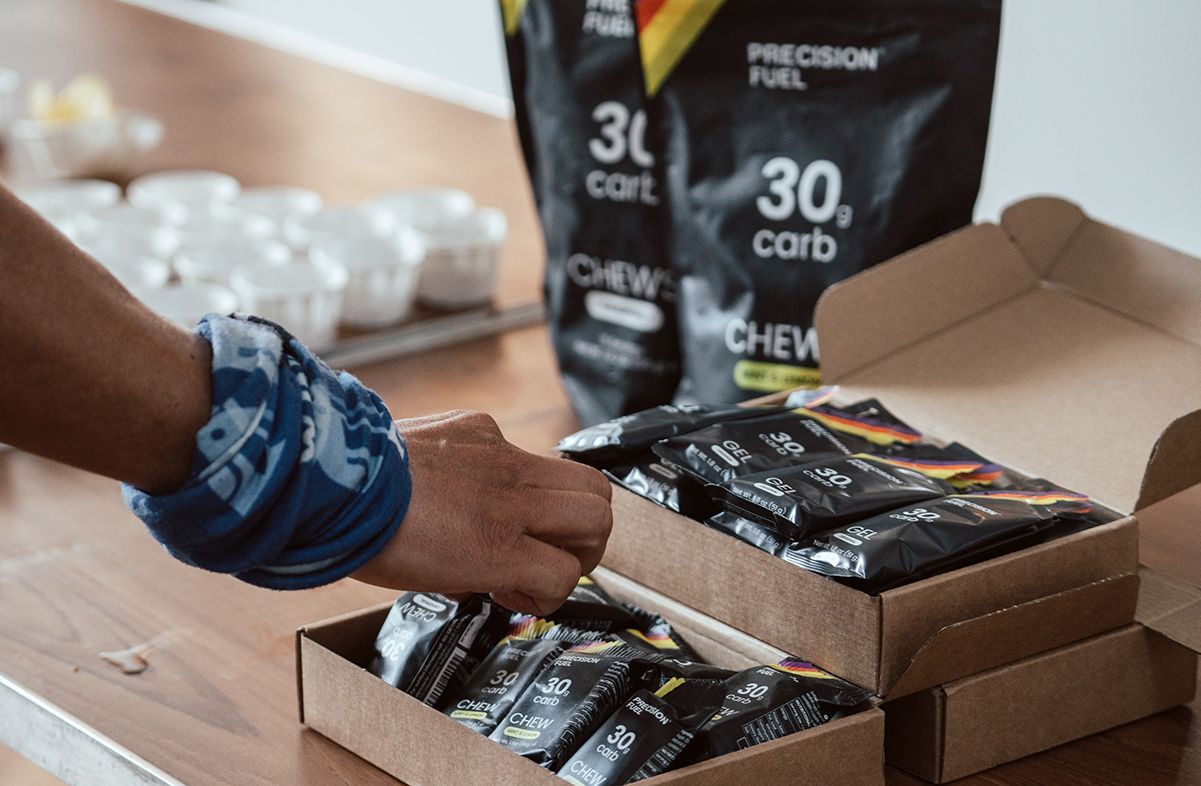
- Gels: Quick, convenient, predictable. A staple.e.g., Precision Fuel Gels - a dependable option with a neutral flavour
- Drink mixes: Great for runners who prefer to sip carbs rather than chew them. Helpful when your appetite drops.e.g., Tailwind mixes often stocked at Centurion events and in the store.
- Chews or blocks: Nice for variety and slower release. Easier psychologically late in a race, but less so if dehydrated. e.g., GU Chews – good texture, easy to portion.
Each format has strengths, and your perfect combination changes depending on the race. A hot Thames Path 100 at 1 p.m. feels different from a cold South Downs Way 100 night section at 3 a.m.
Variety helps both your stomach and your brain, and this is a psychological challenge too.
3. Train your gut the same way you train your legs
Nutrition isn’t something you leave for race day. Your stomach is adaptable and will get better at using the fuel you give it, if you practice. The mistake many runners make is thinking they can force down gels on race day without having used them in training.
Centurion coach (and a man with a PhD focused on runner’s guts) Dr. Jamie Pugh says that “if you’re new to fuelling, or have struggled with digestive issues, structured gut training should be part of race preparation.”
Pick a few products from the Centurion Store that appeal to you, different flavours, different textures, and rotate them through your long runs with some other snacks from the supermarket. Notice:
- how quickly they digest
- whether you feel steady afterwards
- whether you get any bloating
- whether you want to eat them late into your run
- If they make you smile (see jelly meerkats)
If you find yourself avoiding a product after 2-3 hours, it’s not the right race fuel. If you forget you’ve had it 10 minutes later, that’s a winner.
4. Expect taste fatigue (and prepare for it)
Even your favourite flavour gets old after 10-15 hours. Lime becomes “lime for something different”, Berry becomes “Not Berry likely”, Cola becomes an existential crisis.
This is where the flexibility of the Centurion Store range helps. You can choose:
- a primary fuel (one you rely on earlier in the race or as a foundation)
- a backup flavour (to keep things fresh)
- a different texture (chews vs gels vs liquid carbs)
- a simple product for low points (like mild gels or light drink mixes)
- a carb dense product to take over time (a 90g PF gel over 90 minutes)
It’s amazing how far a change in flavour can lift your mood at mile 70. Consistently getting energy in after a dip can change your whole world view.
You don’t want all the gels in your bag on race day though so “use training and B races to experiment with different formats and flavours”. Jamie’s guidance is to “narrow it down to a small number of tried-and-tested options for the big day”.
5. Match your nutrition to the race environment
Different courses and conditions influence what will work:
- Hot races: Drink mixes or lighter gels may be easier to tolerate, especially with higher hydration demands. Avoid only having carb mixes if you might need to increase your hydration intake.
- Cold nights: Chews harden; liquids get colder; gels stay reliable. Hands in gloves make packaging more difficult though.
- Technical terrain: Chews take longer to eat, which can be good or bad depending on footwork skills. Poles can stop you snacking too.
- Flat, continuous running: Drink mixes shine because they fit the rhythm, but it also might be easier to eat a bag of sweets.
Ultra-marathons cover all these scenarios, sometimes all in one race. Experiment with combinations that mimic the conditions you’re likely to face.
6. Build a simple plan, not a strict one
Your plan doesn’t need to look like a military operation. Jamie’s advice is that “on race day, limiting yourself to a few familiar carbohydrate sources, rather than having too many options, makes intake easier to track and reduces decision fatigue”.Your simple plan could even look like this:
- “One gel every 30-40 minutes”
- “Sip drink mix throughout”
- “Switch to chews every third gel”
- “Have two backup flavours in the pack”
- “Graze an extra 10g per hour at every checkpoint”
- “If appetite dips: small bites every 10 minutes”
- “When desire to eat lowers, remember the desire to finish strong and keep chewing”
A flexible plan beats a rigid one. Ultra-running rarely goes exactly as expected. Put the time into building a plan before your race (even with the dreaded spreadsheet) but think about how you will adapt it too.
In summary
Dr. Pugh sums it up well as “the expanding range of sports nutrition products has supported the move toward higher carbohydrate intakes in racing (and probably some of the quicker finish times we are seeing), but the sheer choice can feel overwhelming.”
The right nutrition strategy isn’t complicated, but it is personal. Experiment with products, mix formats, practise during long runs, and listen to your stomach as much as your watch. The Centurion Running Store offers a curated range of fuel designed with ultra-runners in mind, so it’s a brilliant place to start exploring what works for you.
The aim isn’t perfection. It’s consistency, comfort, and confidence that what you’re carrying will help you through the highs, the lows, and the late-night wobbly miles.